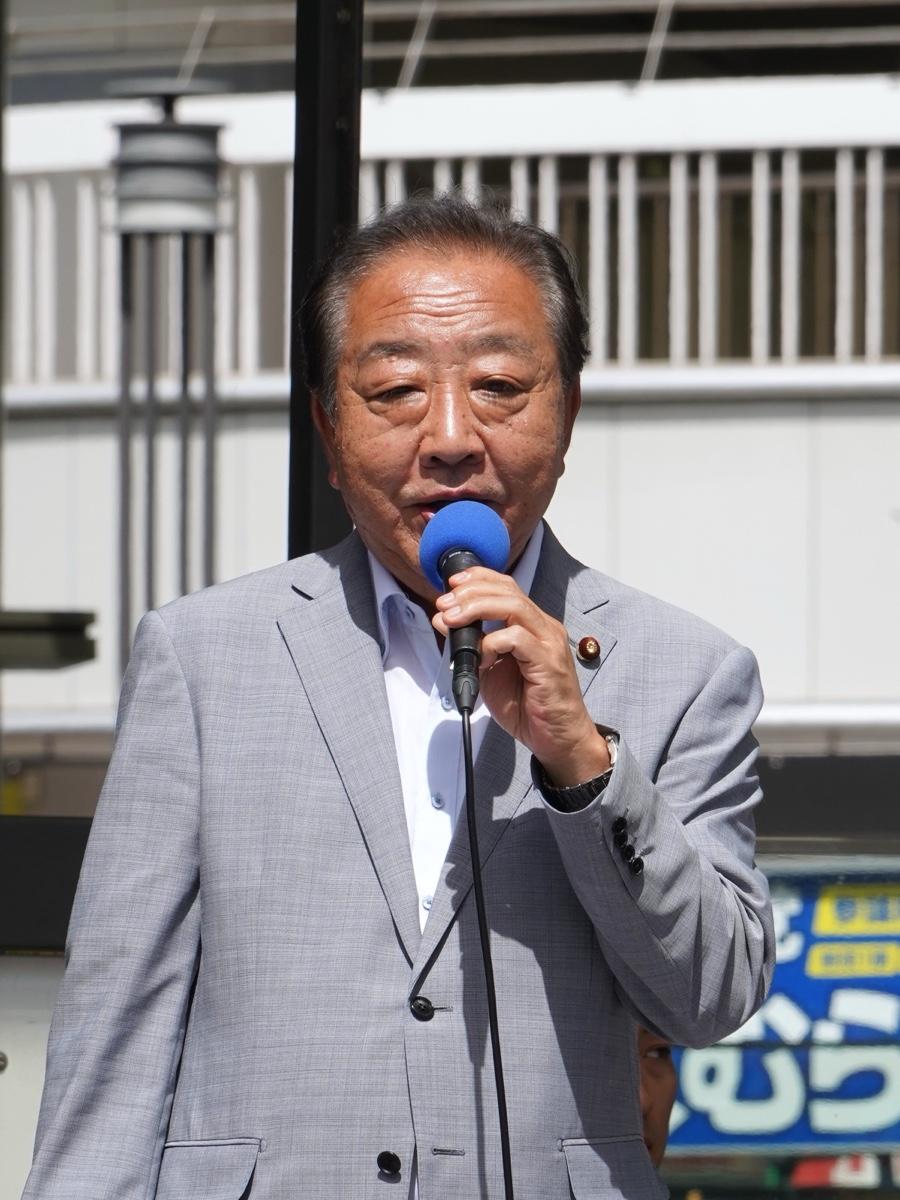
PoliticianPolitical leaning: Center-leftProfile last reviewed: 2026-07-29
Yoshihiko Noda
Adviser, Centrist Reform Alliance; Prime Minister 2011-2012
Grown-up politics as a moral creed: somebody has to pay for the pension bill and somebody has to take the blame - and he volunteers for both, right up to the landslide.
Yoshihiko Noda (野田佳彦) spent 2025 as Japan's opposition leader-in-chief, grilling Prime Minister Sanae Takaichi over her slush-fund-tainted appointments and calling her off-the-cuff Taiwan remarks something a commander-in-chief of the Self-Defense Forces simply must not say. Then he bet everything: in January 2026 he dissolved the Constitutional Democratic Party he had built into a merger with Komeito called the Centrist Reform Alliance, and on February 8 watched it crash from 172 lower-house seats to 49 - resigning the next day with the same stoic fiscal-hawk fatalism he brought to the 2012 consumption-tax hike that destroyed the DPJ. In an era of Trump-style deficit-blind expansion, Noda is the rarer animal: a politician who campaigns on paying the bill, and who has now twice presided over a party losing roughly three-quarters of its seats.
Basis for the leaning assessment
Blue-coded signals: he led Japan's main centre-left opposition and then the anti-LDP Centrist Reform Alliance; he pushed a bill for selective separate surnames for married couples and has told media surveys he supports same-sex marriage; he attacked Takaichi's Taiwan hawkishness as reckless; he opposes an emergency-powers clause in the constitution. Red-coded signals pull him well back toward the centre: he is a self-described fiscal conservative who staked his premiership on raising the consumption tax, he backs revising Article 9 to write the Self-Defense Forces into the constitution, he nationalized the Senkaku Islands in 2012 and restarted the Oi reactors after Fukushima. Japanese left critics explicitly accuse him of dragging the CDP toward centre-right voters, abandoning united opposition candidacies with the Communists, and then liquidating the party in a coup-like merger with Komeito - so the number is deliberately short of a clear blue. He is best read as a centrist institutionalist: a fiscal hawk and security moderate leading the opposition, not a left-winger.
Current Stances
Stances are editorial interpretations, always shown with the statements and actions they rest on.
Leaders name the price of failure in advance, then pay it - and democracy never bargains with violence.
Noda treats personal accountability and parliamentary propriety as the core of democratic legitimacy: he pre-committed in 2025 to resigning if he could not win power, resigned within a day of losing, and used his eulogy for a murdered political opponent to argue that democracy must never yield to violence or terrorism. The same instinct drives his attacks on Takaichi for making security policy off the cuff.
Supporting statements & actions (3)
2022-10-25Speech
I wanted to engage in a fierce battle of words and souls with you again on this floor.
From the memorial address Noda, then an opposition CDP lawmaker and Abe's immediate predecessor as prime minister, delivered for the assassinated Shinzo Abe at a House of Representatives plenary session; he also said democracy should never yield to violence and terrorism, and described Abe as a fighting politician who was kind and caring once he took off his armor.
🔥The LDP and Abe's widow Akie had personally asked the opposition's Noda to give the eulogy because he alone understood the loneliness of the job; the speech drew praise across party lines and is frequently cited as one of the finest orations in modern Diet history.
What Yoshihiko Noda said they would do, in their own words and dated. Where the record settles one, the source for that is shown too. The same goals across everyone are in the promise tracker.
Short-term
Enact selective separate surnames for married couples
Pass legislation letting spouses retain their own surnames, assembling a cross-party lower-house majority that includes Komeito against the LDP's traditional-family wing.
Hold Takaichi to a disciplined, cabinet-agreed line on when a Taiwan contingency would engage Japanese collective self-defense, rather than letting the prime minister voice personal views in Diet questioning.
Does each new statement or decision square with the record? Verdicts are not accusations: both sides of the record are presented so readers can judge for themselves. The same readings across everyone on the site are in the consistency index.
During Diet question time with LDP president Shinzo Abe, Prime Minister Noda proposed dissolving the House of Representatives within two days and holding a general election on December 16 - honoring the promise he had made to LDP president Sadakazu Tanigaki on August 8 to dissolve in the near future in exchange for opposition cooperation that let his consumption-tax bills pass on August 10.
The bills raised the consumption tax from 5% to 8% and then 10% to fund social security; the December 16 election gave Abe's LDP a landslide and cost Noda's DPJ roughly three-quarters of its seats.
🔥The announcement mid-debate blindsided Abe and the press gallery and is still referred to as Noda's November surprise.
The election results are disastrous. We'll naturally take responsibility.
At a press conference the day after the February 8 general election, in which the Centrist Reform Alliance he co-led fell from 172 lower-house seats to 49; he and co-leader Tetsuo Saito both resigned, and Noda separately said the two-co-leader arrangement had been dogged by a sense of being behind the times. Noda himself was re-elected in Chiba's 14th district for an 11th term and became a party adviser on February 18.
Most-Cited Sources from Voterscommunity reading list
Articles readers attached to their poll votes as evidence. Only pages cited independently by two or more voters are listed.
The statements and actions that set social media on fire — top 2, in chronological order. Every entry links to its source.
1
2012-11-14Action
During Diet question time with LDP president Shinzo Abe, Prime Minister Noda proposed dissolving the House of Representatives within two days and holding a general election on December 16 - honoring the promise he had made to LDP president Sadakazu Tanigaki on August 8 to dissolve in the near future in exchange for opposition cooperation that let his consumption-tax bills pass on August 10.
The bills raised the consumption tax from 5% to 8% and then 10% to fund social security; the December 16 election gave Abe's LDP a landslide and cost Noda's DPJ roughly three-quarters of its seats.
🔥The announcement mid-debate blindsided Abe and the press gallery and is still referred to as Noda's November surprise.
I wanted to engage in a fierce battle of words and souls with you again on this floor.
From the memorial address Noda, then an opposition CDP lawmaker and Abe's immediate predecessor as prime minister, delivered for the assassinated Shinzo Abe at a House of Representatives plenary session; he also said democracy should never yield to violence and terrorism, and described Abe as a fighting politician who was kind and caring once he took off his armor.
🔥The LDP and Abe's widow Akie had personally asked the opposition's Noda to give the eulogy because he alone understood the loneliness of the job; the speech drew praise across party lines and is frequently cited as one of the finest orations in modern Diet history.
Timeline of Statements & Actions7 records, newest first
2026-02-09Speech
The election results are disastrous. We'll naturally take responsibility.
At a press conference the day after the February 8 general election, in which the Centrist Reform Alliance he co-led fell from 172 lower-house seats to 49; he and co-leader Tetsuo Saito both resigned, and Noda separately said the two-co-leader arrangement had been dogged by a sense of being behind the times. Noda himself was re-elected in Chiba's 14th district for an 11th term and became a party adviser on February 18.
Rather than an election about changing the government, I have a feeling this will become a political-realignment election - one that holds the possibility that, if the centre can show its presence, both moderate conservatives and liberals will gather together.
Said during a street speech in Tokyo two weeks before the February 8 general election, after Noda had led the CDP into a merger with Komeito to form the Centrist Reform Alliance on January 15. Translated from the Japanese original.
As the supreme commander of the Self-Defense Forces, there are things one must not say. Carelessly voicing personal views is reckless.
In the first party-leaders' debate of Takaichi's premiership, Noda attacked her November 7 Diet remark that a Chinese blockade of Taiwan could constitute a survival-threatening situation for Japan, a comment that triggered a diplomatic crisis with Beijing; he also asked her whether it had been an act of arbitrary decision-making and whether she felt any responsibility.
I ran in the party leadership election in order to achieve a change of government. If I cannot achieve it, then of course I will end up resigning as leader.
Said at a press conference at the Foreign Correspondents' Club of Japan in Tokyo, where Noda described the next general election as the jump after the 2024 lower house hop and the 2025 upper house step. Translated from the Japanese original.
The election results are disastrous. We'll naturally take responsibility.
At a press conference the day after the February 8 general election, in which the Centrist Reform Alliance he co-led fell from 172 lower-house seats to 49; he and co-leader Tetsuo Saito both resigned, and Noda separately said the two-co-leader arrangement had been dogged by a sense of being behind the times. Noda himself was re-elected in Chiba's 14th district for an 11th term and became a party adviser on February 18.
Let married couples keep their own surnames - Japan is the last country on earth that forbids it.
Noda made selective separate surnames a signature legislative demand of his leadership, pushing a joint opposition bill and arguing it could pass the lower house because Komeito backed it too. He has also indicated support for same-sex marriage in media questionnaires, placing him well left of the LDP's traditional-family wing on family law.
Supporting statements & actions (1)
2025-04-30Action
Noda's Constitutional Democratic Party moved to submit a Diet bill creating a system that would let married couples keep their respective surnames, with Noda saying such a bill could pass the lower house with the cooperation of Komeito, which supports the change.
Japan is the only country that legally requires married couples to adopt a single surname, and the LDP's right wing has blocked change for decades. Date is the date of the report.
Deterrence yes, improvisation no: a prime minister must not free-associate about going to war.
A security moderate rather than a pacifist, Noda accepts the alliance and the Self-Defense Forces but insists that a prime minister who is also commander-in-chief has a duty of verbal discipline. He condemned Takaichi's unscripted suggestion that a Chinese blockade of Taiwan could trigger Japanese collective self-defense as reckless and as arbitrary decision-making that damaged relations with Beijing.
Supporting statements & actions (1)
2025-11-26Speech
As the supreme commander of the Self-Defense Forces, there are things one must not say. Carelessly voicing personal views is reckless.
In the first party-leaders' debate of Takaichi's premiership, Noda attacked her November 7 Diet remark that a Chinese blockade of Taiwan could constitute a survival-threatening situation for Japan, a comment that triggered a diplomatic crisis with Beijing; he also asked her whether it had been an act of arbitrary decision-making and whether she felt any responsibility.
Noda's stated project is a wholesale realignment of Japanese politics in which a visible centre pulls in both moderate conservatives and liberals to form an alternative government. The February 2026 rout and his resignation as co-leader left him pursuing this from an advisory role rather than the front bench, so the ambition is undeclared as a comeback plan.
In 2012 Noda traded a dissolution for the votes to raise the consumption tax, and his DPJ lost about three-quarters of its seats to Abe; in 2026 he dissolved the CDP into a hurried merger with Komeito and the resulting Centrist Reform Alliance lost about three-quarters of its seats to Takaichi. Noda's own framing is admirably unchanged: unpopular but necessary decisions come before party self-preservation, and the leader who makes them owes voters an immediate reckoning. Critics on the Japanese left read the same consistency as a fatal pattern - that he twice put a deal with the establishment ahead of his own base, first handing power to Abe and then, as one left analysis put it, liquidating the CDP in a coup-like move that wiped out its progressive wing and confused its supporters. Both readings agree on the facts; they disagree on whether this is integrity or a repeated unforced error.
I ran in the party leadership election in order to achieve a change of government. If I cannot achieve it, then of course I will end up resigning as leader.
Said at a press conference at the Foreign Correspondents' Club of Japan in Tokyo, where Noda described the next general election as the jump after the 2024 lower house hop and the 2025 upper house step. Translated from the Japanese original.
The election results are disastrous. We'll naturally take responsibility.
At a press conference the day after the February 8 general election, in which the Centrist Reform Alliance he co-led fell from 172 lower-house seats to 49; he and co-leader Tetsuo Saito both resigned, and Noda separately said the two-co-leader arrangement had been dogged by a sense of being behind the times. Noda himself was re-elected in Chiba's 14th district for an 11th term and became a party adviser on February 18.
In June 2025 Noda told foreign correspondents that he had sought the leadership to deliver a change of government and would of course resign if he failed; on February 9, 2026, one day after the rout, he resigned and said the party would naturally take responsibility. On his own terms this is a pledge kept without haggling, an unusual thing in Japanese politics. Detractors counter that the promise had become cheap by the time it fell due, because the party he pledged it to had already ceased to exist by his own hand, and that resigning the leadership of a 49-seat rump undoes none of the damage - he stayed on as an adviser with his own seat intact.
I ran in the party leadership election in order to achieve a change of government. If I cannot achieve it, then of course I will end up resigning as leader.
Said at a press conference at the Foreign Correspondents' Club of Japan in Tokyo, where Noda described the next general election as the jump after the 2024 lower house hop and the 2025 upper house step. Translated from the Japanese original.
Rather than an election about changing the government, I have a feeling this will become a political-realignment election - one that holds the possibility that, if the centre can show its presence, both moderate conservatives and liberals will gather together.
Said during a street speech in Tokyo two weeks before the February 8 general election, after Noda had led the CDP into a merger with Komeito to form the Centrist Reform Alliance on January 15. Translated from the Japanese original.
Eight months after staking his leadership on winning power outright, Noda stood on a Tokyo street two weeks before polling day and reframed the contest as a realignment election rather than a change-of-government election. He would say this was honest reading of a fragmenting electorate in which the centre's job was to attract moderate conservatives and liberals before it could govern. Opponents and some of his own supporters saw goalpost-moving in real time - a leader lowering the bar he had set himself because he already knew he would not clear it, which is precisely the impression that helped the alliance shed more than 120 seats.
I ran in the party leadership election in order to achieve a change of government. If I cannot achieve it, then of course I will end up resigning as leader.
Said at a press conference at the Foreign Correspondents' Club of Japan in Tokyo, where Noda described the next general election as the jump after the 2024 lower house hop and the 2025 upper house step. Translated from the Japanese original.
Noda's Constitutional Democratic Party moved to submit a Diet bill creating a system that would let married couples keep their respective surnames, with Noda saying such a bill could pass the lower house with the cooperation of Komeito, which supports the change.
Japan is the only country that legally requires married couples to adopt a single surname, and the LDP's right wing has blocked change for decades. Date is the date of the report.
I wanted to engage in a fierce battle of words and souls with you again on this floor.
From the memorial address Noda, then an opposition CDP lawmaker and Abe's immediate predecessor as prime minister, delivered for the assassinated Shinzo Abe at a House of Representatives plenary session; he also said democracy should never yield to violence and terrorism, and described Abe as a fighting politician who was kind and caring once he took off his armor.
🔥The LDP and Abe's widow Akie had personally asked the opposition's Noda to give the eulogy because he alone understood the loneliness of the job; the speech drew praise across party lines and is frequently cited as one of the finest orations in modern Diet history.
During Diet question time with LDP president Shinzo Abe, Prime Minister Noda proposed dissolving the House of Representatives within two days and holding a general election on December 16 - honoring the promise he had made to LDP president Sadakazu Tanigaki on August 8 to dissolve in the near future in exchange for opposition cooperation that let his consumption-tax bills pass on August 10.
The bills raised the consumption tax from 5% to 8% and then 10% to fund social security; the December 16 election gave Abe's LDP a landslide and cost Noda's DPJ roughly three-quarters of its seats.
🔥The announcement mid-debate blindsided Abe and the press gallery and is still referred to as Noda's November surprise.