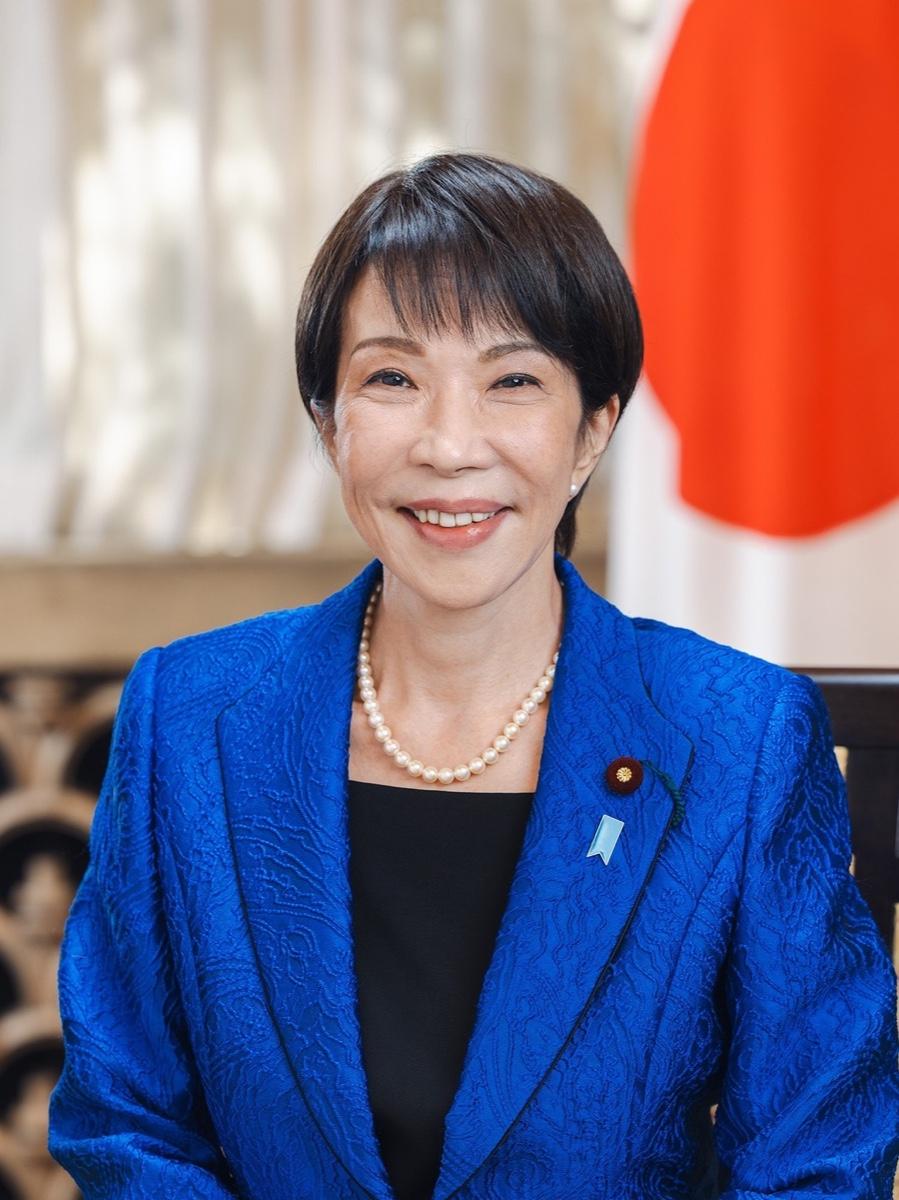
PoliticianPolitical leaning: ConservativeProfile last reviewed: 2026-07-29
Sanae Takaichi
Prime Minister of Japan
Abe's unfinished business, executed by a self-described workhorse: rewrite the constitution, rearm the country, keep the throne male — and never say 'work-life balance' again.
Sanae Takaichi (高市早苗) became Japan's first woman prime minister on October 21, 2025 after Komeito walked out on the LDP and she rebuilt the coalition with the Japan Innovation Party, then gambled on a snap election and won the largest single-party haul in the history of the postwar lower house — 316 of 465 seats, up 118, and 352 with Ishin. She is the most complete expression yet of the Abe right: a two-thirds bloc aimed at Article 9, defense spending pulled up to 2% of GDP two years early, a 'zero illegal overstayers' plan, and a November 2025 Taiwan remark that cost Japan its seafood exports to China and its rare-earth supply — while she has been an unusually easy partner for Trump on rare earths and nuclear cooperation, and her deficit-funded 'Sanaenomics' has pushed 40-year JGB yields past 4%, the inverse of the austerity-first playbook Milei made famous. The paradox Japan keeps circling back to: the first woman to hold the job legislated the imperial throne shut to women, opposes selective separate surnames and same-sex marriage, and told the country to abandon work-life balance — a line that by July 2026 had turned into a national argument about karoshi.
Basis for the leaning assessment
Strongly red on almost every marker in the Japan mapping: constitutional revision as her signature project (Article 9 and the legal status of the SDF), an accelerated defense buildup and revision of the three strategic documents, the hardest public line on a Taiwan contingency any sitting Japanese PM has taken, restrictive policy on foreign nationals and foreign land purchases, opposition to selective separate surnames and same-sex marriage, and a revised Imperial House Law enshrining male-line succession. Yasukuni is a partial qualifier — she sent a ritual offering in April 2026 but skipped the visit she once pledged, which is tactical moderation rather than a change of view. The one genuinely cross-cutting signal is economics: 'Sanaenomics' is anti-austerity fiscal expansion, not small-government conservatism, and her policy speeches attack 'excessive austerity and underinvestment' in language a left-populist could use. I weighted the security, constitutional and family-policy record much more heavily than the fiscal stance, hence 78 rather than the high 80s. This is an editorial estimate.
Current Stances
Stances are editorial interpretations, always shown with the statements and actions they rest on.
The postwar constitution has to be rewritten, and Article 9 first — the Self-Defense Forces should stop existing in a legal grey zone.
Takaichi treats constitutional revision as the point of her premiership, and the February 2026 landslide handed her the two-thirds lower-house bloc needed to propose one. She has since framed it in consensus language — a cross-party Diet proposal 'at an early time' — because she still lacks two-thirds in the upper house and would then need to win a first-ever national referendum.
Supporting statements & actions (2)
2026-02-08Action
Won a snap election she had called by dissolving the lower house on January 23, 2026: the LDP took 316 of 465 seats, a gain of 118 and the largest number ever won by a single party in the postwar lower house, giving her bloc 352 seats with the Japan Innovation Party's 36 — comfortably past the two-thirds needed to propose a constitutional amendment.
Seat figures from the CSIS analysis published February 9, 2026, the day after the vote. Her bloc remains short of two-thirds in the upper house.
Regarding constitutional reform, I have great hopes that constructive discussions transcending political parties and factions will gather momentum, leading to the release of a Diet proposal at an early time.
From her policy speech to the 221st session of the Diet, her first after the landslide; the same speech promised to 'bring forward the revision of the Three Strategic Documents within this year' and to deepen discussion of 'stable Imperial succession' via the Imperial House Law.
Goals
What Sanae Takaichi said they would do, in their own words and dated. Where the record settles one, the source for that is shown too. The same goals across everyone are in the promise tracker.
Short-term
Lock in 2%-of-GDP defense spending and rewrite the three strategic documents
Hold defense-related spending at 2% of GDP — a target she pulled forward from fiscal 2027 to the year ending March 2026 — and finish an early revision of the National Security Strategy, National Defense Strategy and Defense Buildup Program within 2026, including reorganizing the Air Self-Defense Force into an Air and Space Self-Defense Force.
Get a cross-party Diet proposal out of both chambers and win Japan's first-ever constitutional referendum, clarifying the legal status of the Self-Defense Forces under Article 9. No amendment has ever been proposed, let alone passed, since the constitution took effect in 1947.
Does each new statement or decision square with the record? Verdicts are not accusations: both sides of the record are presented so readers can judge for themselves. The same readings across everyone on the site are in the consistency index.
I will abandon the phrase 'work-life balance.' I will work, work, work, work and keep on working.
Said in her acceptance speech after winning the LDP presidency, alongside a call for party lawmakers to 'work like workhorses.' Translated from the Japanese original.
🔥Named Japan's catchphrase of the year for 2025 and became her defining soundbite — repeated endlessly on Japanese TV and X, and the reference point for every subsequent argument about her schedule.
I was able to get five hours of sleep for the first time in a while. Since taking office, getting zero to three hours of sleep has become the norm.
Posted on her X account on the Monday night of the Marine Day holiday weekend, after she said she had spent it reading policy documents and catching up on ironing and sewing; the wording is TIME's translation of the Japanese original.
Reopened Japan's argument about karoshi — death by overwork — within days, with opposition leader Yuichiro Tamaki responding that 'resting is part of her job' and lawmaker Toru Kunishige warning that sleep deprivation 'impairs judgment, much like a state of intoxication,' at a moment when the Tokyo metropolitan government is moving its own staff to a four-day week.
Most-Cited Sources from Voterscommunity reading list
Articles readers attached to their poll votes as evidence. Only pages cited independently by two or more voters are listed.
The statements and actions that set social media on fire — top 4, in chronological order. Every entry links to its source.
1
2016-04-21Speech
Article 4 of the Broadcast Act stipulates that broadcasters shall be 'politically fair' and that the internal affairs minister shall determine whether this provision is being upheld. The minister is also legally authorized to order stations and networks that repeatedly violate the law to suspend broadcasting operations.
Said as internal affairs and communications minister in a Lower House Budget Committee session in February 2016; the date shown is the date of the cited nippon.com report, which is the source for the wording. Constitutional scholars had long read Article 4 as a voluntary code of ethics rather than grounds for suspension.
🔥Set off a public protest by five prominent Japanese broadcast journalists who accused the Abe government of pressuring newsrooms; she never retracted it, and it is still the standard citation for the argument that Japan's press freedom slid under Abe.
I will abandon the phrase 'work-life balance.' I will work, work, work, work and keep on working.
Said in her acceptance speech after winning the LDP presidency, alongside a call for party lawmakers to 'work like workhorses.' Translated from the Japanese original.
🔥Named Japan's catchphrase of the year for 2025 and became her defining soundbite — repeated endlessly on Japanese TV and X, and the reference point for every subsequent argument about her schedule.
Timeline of Statements & Actions7 records, newest first
2026-07-20Social post
I was able to get five hours of sleep for the first time in a while. Since taking office, getting zero to three hours of sleep has become the norm.
Posted on her X account on the Monday night of the Marine Day holiday weekend, after she said she had spent it reading policy documents and catching up on ironing and sewing; the wording is TIME's translation of the Japanese original.
🔥Reopened Japan's argument about karoshi — death by overwork — within days, with opposition leader Yuichiro Tamaki responding that 'resting is part of her job' and lawmaker Toru Kunishige warning that sleep deprivation 'impairs judgment, much like a state of intoxication,' at a moment when the Tokyo metropolitan government is moving its own staff to a four-day week.
Her government pushed through a revision of the 19th-century Imperial House Law restricting the throne to men of paternal-line imperial descent, permitting the adoption of male relatives aged 15 or over from former branch families to father future heirs, and letting princesses keep royal status on marrying commoners while their husbands and children do not. Takaichi and allied conservatives hold that the male bloodline is 'the only source of the emperor's authority and legitimacy.'
The revision closes the door on Princess Aiko, the emperor's only child, and rejects the option of retaining female members' status in the line of succession that a 2021 expert panel had left open.
Equal opportunity for women, but no change to the traditional family and none at all to the male imperial line.
Japan's first woman prime minister opposes selective separate surnames for married couples (offering wider use of maiden names as aliases instead) and same-sex marriage, and in July 2026 legislated male paternal-line succession into the Imperial House Law. She had campaigned on bringing women's representation in top posts to a level 'not particularly lower than Nordic countries' and then named two women to a 19-member cabinet.
Supporting statements & actions (1)
2026-07-17Action
Her government pushed through a revision of the 19th-century Imperial House Law restricting the throne to men of paternal-line imperial descent, permitting the adoption of male relatives aged 15 or over from former branch families to father future heirs, and letting princesses keep royal status on marrying commoners while their husbands and children do not. Takaichi and allied conservatives hold that the male bloodline is 'the only source of the emperor's authority and legitimacy.'
The revision closes the door on Princess Aiko, the emperor's only child, and rejects the option of retaining female members' status in the line of succession that a 2021 expert panel had left open.
Deterrence beats ambiguity: a Chinese blockade of Taiwan could be Japan's own survival crisis, and Japan should say so out loud.
In November 2025 she became the first sitting Japanese premier to publicly tie a Taiwan contingency to the possible use of Japanese force, and she refused Beijing's demand for a retraction through eight months of travel advisories, seafood bans and export controls. She paired this with pulling defense spending up to 2% of GDP two years early and an accelerated rewrite of the three strategic documents.
Supporting statements & actions (2)
2025-11-07Speech
Told the Lower House Budget Committee that a Chinese naval blockade of Taiwan involving warships and the use of force could, by any measure, amount to a 'survival-threatening situation' for Japan — the legal trigger under the 2015 security laws for Japan to exercise collective self-defense.
The first time a sitting Japanese prime minister publicly linked a Taiwan Strait crisis to the possible use of Japanese forces, abandoning decades of deliberate ambiguity; rendered here as an event description because English translations of her exact wording differ.
🔥Triggered the worst China-Japan rupture in a decade: Beijing issued a travel advisory against Japan on November 14, halted Japanese seafood imports on November 19, cancelled cultural exchanges and later restricted dual-use and rare-earth exports. Japanese tourism and retail stocks fell 5-10% in a week.
Regarding constitutional reform, I have great hopes that constructive discussions transcending political parties and factions will gather momentum, leading to the release of a Diet proposal at an early time.
From her policy speech to the 221st session of the Diet, her first after the landslide; the same speech promised to 'bring forward the revision of the Three Strategic Documents within this year' and to deepen discussion of 'stable Imperial succession' via the Imperial House Law.
Her real bottleneck: the LDP-Ishin coalition holds a supermajority in the lower house but only a minority in the House of Councillors, where in July 2026 it had to force a second-capital bill through by a razor-thin margin. She has not said how she intends to get to two-thirds there — by courting opposition parties, by the next upper-house election, or by another gamble.
Nine months after telling the LDP she would abandon the phrase 'work-life balance' and work like a workhorse, she posted that zero-to-three hours of sleep had become her norm — she has done exactly what she promised, which is the problem. Her own framing is that the job of prime minister in a security and inflation crisis demands personal sacrifice, that she is describing herself and not prescribing for anyone else, and that voters rewarded precisely this ethic with the biggest single-party win in postwar history. Critics answer that in the country that gave the world the word karoshi, the prime minister modelling sleep deprivation as virtue is a labour-policy statement whether she intends it or not, especially while the Tokyo metropolitan government moves its own staff to a four-day week: Yuichiro Tamaki said 'resting is part of her job,' and Toru Kunishige argued that a sleep-deprived leader's judgment is impaired 'much like a state of intoxication,' making it a national crisis-management risk rather than a personal quirk.
Told the Lower House Budget Committee that a Chinese naval blockade of Taiwan involving warships and the use of force could, by any measure, amount to a 'survival-threatening situation' for Japan — the legal trigger under the 2015 security laws for Japan to exercise collective self-defense.
The first time a sitting Japanese prime minister publicly linked a Taiwan Strait crisis to the possible use of Japanese forces, abandoning decades of deliberate ambiguity; rendered here as an event description because English translations of her exact wording differ.
🔥Triggered the worst China-Japan rupture in a decade: Beijing issued a travel advisory against Japan on November 14, halted Japanese seafood imports on November 19, cancelled cultural exchanges and later restricted dual-use and rare-earth exports. Japanese tourism and retail stocks fell 5-10% in a week.
Regarding constitutional reform, I have great hopes that constructive discussions transcending political parties and factions will gather momentum, leading to the release of a Diet proposal at an early time.
From her policy speech to the 221st session of the Diet, her first after the landslide; the same speech promised to 'bring forward the revision of the Three Strategic Documents within this year' and to deepen discussion of 'stable Imperial succession' via the Imperial House Law.
The Takaichi of November 2025 broke sixty years of studied ambiguity in an unscripted committee answer and then absorbed travel advisories, a seafood ban and rare-earth export controls rather than retract a word. The Takaichi of February 2026, holding a two-thirds bloc, described her signature project in the language of 'constructive discussions transcending political parties and factions' — and in April 2026 sent a ritual offering to Yasukuni rather than making the visit she had once pledged, citing the state of relations with Beijing and Seoul. Her camp calls this the discipline of governing: a supermajority makes patience affordable, and an amendment that passes by consensus and referendum is far more durable than one rammed through. Critics call it arithmetic, not conviction — she needs upper-house votes she does not have and a referendum majority she may never get, and nothing about the Taiwan remark or its costs has been walked back, so the moderation is a posture that can be dropped as easily as it was adopted.
Article 4 of the Broadcast Act stipulates that broadcasters shall be 'politically fair' and that the internal affairs minister shall determine whether this provision is being upheld. The minister is also legally authorized to order stations and networks that repeatedly violate the law to suspend broadcasting operations.
Said as internal affairs and communications minister in a Lower House Budget Committee session in February 2016; the date shown is the date of the cited nippon.com report, which is the source for the wording. Constitutional scholars had long read Article 4 as a voluntary code of ethics rather than grounds for suspension.
🔥Set off a public protest by five prominent Japanese broadcast journalists who accused the Abe government of pressuring newsrooms; she never retracted it, and it is still the standard citation for the argument that Japan's press freedom slid under Abe.
Her government pushed through a revision of the 19th-century Imperial House Law restricting the throne to men of paternal-line imperial descent, permitting the adoption of male relatives aged 15 or over from former branch families to father future heirs, and letting princesses keep royal status on marrying commoners while their husbands and children do not. Takaichi and allied conservatives hold that the male bloodline is 'the only source of the emperor's authority and legitimacy.'
The revision closes the door on Princess Aiko, the emperor's only child, and rejects the option of retaining female members' status in the line of succession that a 2021 expert panel had left open.
The same instinct runs through both: read the letter of an old statute strictly, and use it to close a space other people thought was open. In 2016 she told the Diet that Article 4 of the Broadcast Act let a minister judge political fairness and suspend broadcasters; in 2026 she legislated the male paternal line into the Imperial House Law and shut Princess Aiko out. Takaichi's framing is that she is not innovating at all — the law says what it says, the male bloodline is in her account 'the only source of the emperor's authority and legitimacy,' and treating tradition as an important treasure unique to Japan is a conservative's duty, not a personal preference. Critics see legal literalism deployed as a weapon: journalists in 2016 read her reading of a code of ethics as a licence to intimidate newsrooms, and on succession the historian Hideya Kawanishi called the revision 'a declaration to prevent female monarchs — they cannot say it's male chauvinism, so they call it tradition,' while the feminist scholar Chizuko Ueno noted the irony that 'the first female prime minister herself is the leading proponent of the obsession with male-succession.'
Told the Lower House Budget Committee that a Chinese naval blockade of Taiwan involving warships and the use of force could, by any measure, amount to a 'survival-threatening situation' for Japan — the legal trigger under the 2015 security laws for Japan to exercise collective self-defense.
The first time a sitting Japanese prime minister publicly linked a Taiwan Strait crisis to the possible use of Japanese forces, abandoning decades of deliberate ambiguity; rendered here as an event description because English translations of her exact wording differ.
🔥Triggered the worst China-Japan rupture in a decade: Beijing issued a travel advisory against Japan on November 14, halted Japanese seafood imports on November 19, cancelled cultural exchanges and later restricted dual-use and rare-earth exports. Japanese tourism and retail stocks fell 5-10% in a week.
I was able to get five hours of sleep for the first time in a while. Since taking office, getting zero to three hours of sleep has become the norm.
Posted on her X account on the Monday night of the Marine Day holiday weekend, after she said she had spent it reading policy documents and catching up on ironing and sewing; the wording is TIME's translation of the Japanese original.
🔥Reopened Japan's argument about karoshi — death by overwork — within days, with opposition leader Yuichiro Tamaki responding that 'resting is part of her job' and lawmaker Toru Kunishige warning that sleep deprivation 'impairs judgment, much like a state of intoxication,' at a moment when the Tokyo metropolitan government is moving its own staff to a four-day week.
Regarding constitutional reform, I have great hopes that constructive discussions transcending political parties and factions will gather momentum, leading to the release of a Diet proposal at an early time.
From her policy speech to the 221st session of the Diet, her first after the landslide; the same speech promised to 'bring forward the revision of the Three Strategic Documents within this year' and to deepen discussion of 'stable Imperial succession' via the Imperial House Law.
Won a snap election she had called by dissolving the lower house on January 23, 2026: the LDP took 316 of 465 seats, a gain of 118 and the largest number ever won by a single party in the postwar lower house, giving her bloc 352 seats with the Japan Innovation Party's 36 — comfortably past the two-thirds needed to propose a constitutional amendment.
Seat figures from the CSIS analysis published February 9, 2026, the day after the vote. Her bloc remains short of two-thirds in the upper house.
Told the Lower House Budget Committee that a Chinese naval blockade of Taiwan involving warships and the use of force could, by any measure, amount to a 'survival-threatening situation' for Japan — the legal trigger under the 2015 security laws for Japan to exercise collective self-defense.
The first time a sitting Japanese prime minister publicly linked a Taiwan Strait crisis to the possible use of Japanese forces, abandoning decades of deliberate ambiguity; rendered here as an event description because English translations of her exact wording differ.
🔥Triggered the worst China-Japan rupture in a decade: Beijing issued a travel advisory against Japan on November 14, halted Japanese seafood imports on November 19, cancelled cultural exchanges and later restricted dual-use and rare-earth exports. Japanese tourism and retail stocks fell 5-10% in a week.
I will abandon the phrase 'work-life balance.' I will work, work, work, work and keep on working.
Said in her acceptance speech after winning the LDP presidency, alongside a call for party lawmakers to 'work like workhorses.' Translated from the Japanese original.
🔥Named Japan's catchphrase of the year for 2025 and became her defining soundbite — repeated endlessly on Japanese TV and X, and the reference point for every subsequent argument about her schedule.
Article 4 of the Broadcast Act stipulates that broadcasters shall be 'politically fair' and that the internal affairs minister shall determine whether this provision is being upheld. The minister is also legally authorized to order stations and networks that repeatedly violate the law to suspend broadcasting operations.
Said as internal affairs and communications minister in a Lower House Budget Committee session in February 2016; the date shown is the date of the cited nippon.com report, which is the source for the wording. Constitutional scholars had long read Article 4 as a voluntary code of ethics rather than grounds for suspension.
🔥Set off a public protest by five prominent Japanese broadcast journalists who accused the Abe government of pressuring newsrooms; she never retracted it, and it is still the standard citation for the argument that Japan's press freedom slid under Abe.