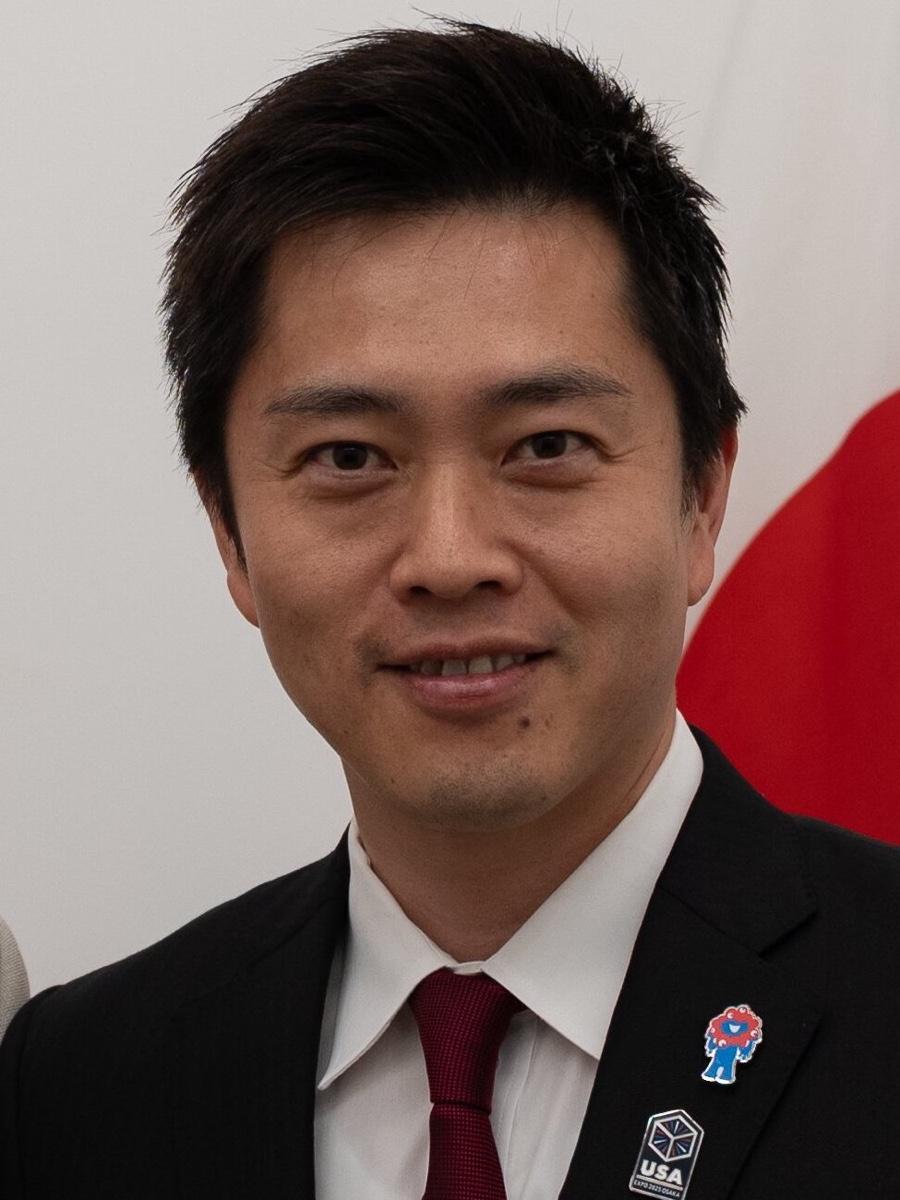
PoliticianPolitical leaning: Center-rightProfile last reviewed: 2026-07-29
Hirofumi Yoshimura
Leader, Japan Innovation Party; Governor of Osaka
Reform as a permanent campaign: shrink the Diet, break Tokyo's monopoly on the state, and keep re-running the referendum until Osaka says yes — even if the vested interest he now sits inside is the LDP.
Hirofumi Yoshimura (吉村洋文), a lawyer turned Osaka mayor turned three-term governor, became a household name through nightly COVID briefings and the traffic-light "Osaka model" before delivering Expo 2025 Osaka-Kansai, which closed in October 2025 with roughly 28 million visitors and an operating surplus. In October 2025 he took the party founded to smash Japan's establishment into coalition with it, supplying the votes that made Sanae Takaichi the first woman prime minister — then in January 2026 resigned as governor to force a snap double election, won a third term with 83.2%, and used Ishin's leverage to get a "second capital" law enacted in July 2026. He is Japan's closest analogue to a Milei-style institutional disruptor crossed with a Newsom-style pandemic-era governor: a small-government scold on the Diet's payroll who also made high school free.
Basis for the leaning assessment
Red-coded signals dominate the 2025-26 record: the coalition agreement he personally signed with Takaichi commits the two parties to a joint drafting council on revising Article 9, to male-line-only expansion of the Imperial Family, to a National Emblem Protection Law criminalizing flag desecration, to numerical caps and land-purchase restrictions on foreign residents, and to restarting nuclear plants — and Ishin's own constitutional position (delete Article 9 Paragraph 2, replace the Self-Defense Forces with a National Defense Force) is to the right of the LDP's. But Ishin reformism is genuinely cross-cutting and should not be read as plain conservatism: Yoshimura made Osaka the first prefecture to abolish high school tuition and pushed free school lunches and a food consumption-tax pause into the national coalition deal, his party has historically backed same-sex marriage and optional separate surnames (positions the coalition deal traded down to "maiden names as common names"), and his signature causes — cutting 10% of Lower House seats, decentralization, a second capital — are anti-Tokyo institutional disruption rather than left/right. A defensible range is +40 to +50; the welfare and social-liberal streak is what keeps him out of the +60s.
Current Stances
Stances are editorial interpretations, always shown with the statements and actions they rest on.
Austerity & the Stateobserved 2025-10-20 – 2026-07-24
Shrink the political class first, then talk about taxes — but keep education free.
Yoshimura's small-government instinct aims at the state's own overhead: a 10% cut to Lower House seats as the price of his coalition support, deregulation and a leaner bureaucracy, plus a ban on corporate political donations. It is a selective austerity, since he simultaneously drove free high school tuition, free school lunches and a food consumption-tax pause into the national agenda.
Supporting statements & actions (3)
2025-10-20Interview
Politics should be about taking risks when necessary to open up new paths.
Speaking on television the day Ishin signed its coalition agreement with the LDP; he called it a very difficult decision because parties that had previously joined LDP coalitions had disappeared.
2026-07-07Speech
I believe cutting the number of lawmakers is the central pillar of reform, and it is something we must see through. At this point, of course, they are not something we will withdraw.
After meeting Takaichi during a Diet stalemate in which every opposition party boycotted deliberations and demanded the ruling bloc drop both the seat-reduction and second-capital bills; the seat-cut bill was later postponed to a future session.
Goals
What Hirofumi Yoshimura said they would do, in their own words and dated. Where the record settles one, the source for that is shown too. The same goals across everyone are in the promise tracker.
Short-term
Win a third Osaka metropolis referendum
ActiveConvert his 83.2% re-election into a third citywide vote on abolishing Osaka city and merging its 24 wards into Tokyo-style special wards — the party's founding project, defeated in 2015 and 2020 and now backed by a national second-capital law.
Declared: 2026-02-08Source ↗
Enact the 10% cut to Lower House seats
ActiveDeliver the coalition condition he called the central pillar of reform — cutting the Lower House from 465 seats to about 420 by removing roughly 25 constituency and 20 proportional seats — after Takaichi postponed the bill in July 2026 under an opposition boycott.
Declared: 2026-07-07Source ↗
Consistency Tracker
Does each new statement or decision square with the record? Verdicts are not accusations: both sides of the record are presented so readers can judge for themselves. The same readings across everyone on the site are in the consistency index.
Earlier statement / action
2020-11-02Speech
Told reporters after Osaka voters rejected the metropolis plan for a second time that he took the result seriously and firmly promised he would not attempt the merger plan a third time, saying he wanted to serve out the remaining two and a half years of his term.
The November 1, 2020 referendum on abolishing Osaka city and merging its 24 wards failed 50.63% to 49.37%, a margin of 17,167 votes; Mayor Ichiro Matsui announced he would leave politics over it.
Later statement / action
2026-02-08Action
Resigned as governor in January 2026 to trigger a snap gubernatorial election on the same day as Takaichi's snap general election, explicitly to win a mandate for a third referendum on merging Osaka city's wards — and was re-elected to a third term with 83.2% of the vote, beating two independents who opposed the merger.
Osaka Mayor Hideyuki Yokoyama resigned and won re-election alongside him; the double-election gamble had drawn objections from Ishin's own Osaka city assembly members and from veteran Diet members.
Most-Cited Sources from Voterscommunity reading list
Articles readers attached to their poll votes as evidence. Only pages cited independently by two or more voters are listed.
- 1Liberal 1Conservative 5
- 2www.nippon.com/en/in-depth/d00646 ↗
Cited by 4 voters
Liberal 1Conservative 3 - 3Liberal 1Conservative 2
Most-Discussed Moments
The statements and actions that set social media on fire — top 1, in chronological order. Every entry links to its source.
- 2020-08-04Speech
[It's] worth giving a try. Everyone can buy [it] and it doesn't do any harm.
At an Osaka prefectural news conference Yoshimura presented a 41-patient trial and said gargling with povidone-iodine could reduce the virus in the mouth; he walked the claim back the next day, saying the gargle had no clear preventive effect.
Japan's single most-mocked COVID press conference: drugstores nationwide were stripped of gargle solution within hours, resellers listed bottles at up to 5,000 yen, Meiji Holdings shares jumped as much as 7.7%, and the WHO's Kobe centre and the Japan Medical Association publicly contradicted him.
Timeline of Statements & Actions7 records, newest first
2026-07-24Action
Ishin's flagship coalition demand became law: the House of Councillors passed the secondary-capital bill 123-121 after the Diet session was extended eight days specifically to get it through, creating a designated district outside Tokyo to assume core government functions in a major disaster.
All major opposition parties voted against, arguing the bill was tailored to the Osaka-based Japan Innovation Party even though it names no city.
2026-07-07Speech
I believe cutting the number of lawmakers is the central pillar of reform, and it is something we must see through. At this point, of course, they are not something we will withdraw.
After meeting Takaichi during a Diet stalemate in which every opposition party boycotted deliberations and demanded the ruling bloc drop both the seat-reduction and second-capital bills; the seat-cut bill was later postponed to a future session.
2026-02-08Action
Resigned as governor in January 2026 to trigger a snap gubernatorial election on the same day as Takaichi's snap general election, explicitly to win a mandate for a third referendum on merging Osaka city's wards — and was re-elected to a third term with 83.2% of the vote, beating two independents who opposed the merger.
Osaka Mayor Hideyuki Yokoyama resigned and won re-election alongside him; the double-election gamble had drawn objections from Ishin's own Osaka city assembly members and from veteran Diet members.
More from Japan
Share this record
Every claim above carries its source, so the page holds up wherever it lands.