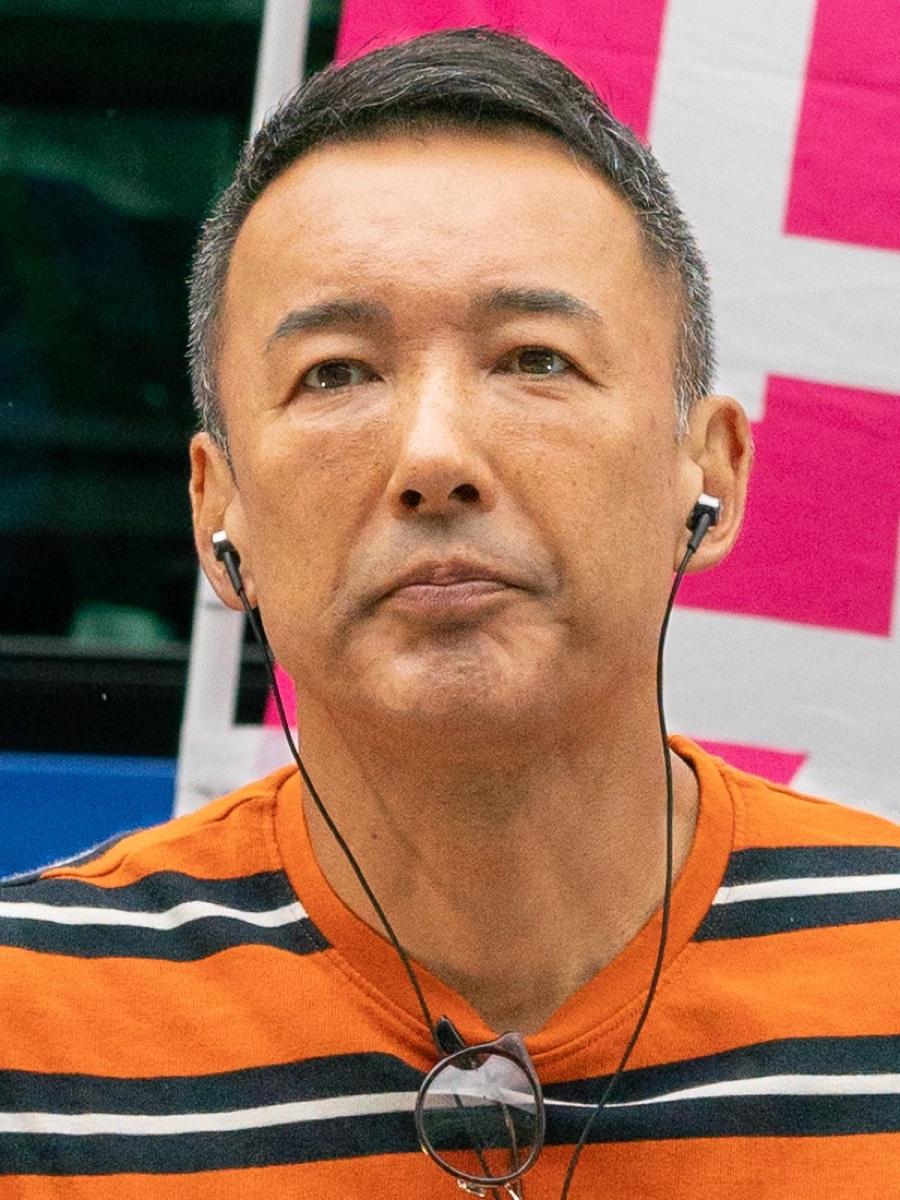
PoliticianPolitical leaning: LiberalProfile last reviewed: 2026-07-29
Taro Yamamoto
Founder and outgoing leader, Reiwa Shinsengumi
Anti-austerity as triage: the yen is never the constraint, poverty is the emergency — and when argument fails, put your body in front of the vote.
Taro Yamamoto (山本太郎) — the Battle Royale actor who became an anti-nuclear agitator, lost his screen career over it, and founded Reiwa Shinsengumi in 2019 — spent 2025 as Japan's loudest left-populist, demanding outright abolition of the consumption tax and 100,000-yen cash handouts every season financed by government bonds, calling Sanae Takaichi's 80-trillion-yen Trump investment pact 'protection money' and her military buildup a betrayal of the poor. His AOC-and-Mamdani-style street-rally, small-donor operation peaked at nine lower-house seats in October 2024 and then collapsed: he quit the House of Councillors in January 2026 after a checkup found him a stage short of multiple myeloma, Reiwa fell from nine seats to one in Takaichi's February 8, 2026 landslide, and on July 9, 2026 he resigned the leadership and renounced electoral politics entirely after a 149 km/h speeding conviction came to light. The party he built holds a leadership election on July 31, 2026 and will change its name.
Basis for the leaning assessment
Strongly blue-coded on almost every Japan-specific signal the axis tracks: anti-nuclear-power (his entire origin story, and he attacks the Kashiwazaki-Kariwa restart smuggled into the FY2025 supplementary budget), pacifism and open hostility to the defense buildup and the defense tax hike, defense of the postwar constitution against Article 9 revision and emergency clauses, welfare and labor expansion, disability rights written into his party's candidate selection, and a pro-refugee position so intense he physically tried to block the 2023 immigration bill for not protecting asylum seekers enough. Discounted from a maximal blue score because his method and some of his rhetoric are cross-cutting populism rather than left liberalism: maximal tax-cutting that competes directly with the populist right (Sanseito, DPFP), 'selling out the country' (baikoku) economic nationalism aimed at the US tariff deal that reads as easily on the nationalist right, and a call for Japanese neutrality and no sanctions over Ukraine that overlaps with the anti-interventionist right. This is an editorial estimate.
Current Stances
Stances are editorial interpretations, always shown with the statements and actions they rest on.
Abolish the consumption tax and pay everyone 100,000 yen a season, financed by bonds — the deficit is not the constraint, destitution is.
Yamamoto's central demand is total abolition of Japan's consumption tax plus recurring universal cash payments, with government bond issuance as the explicit funding source and growth treated as the revenue that follows rather than the precondition. He frames Japan's thirty lost years, the fall in median household income and record small-business bankruptcies as the direct result of consumption tax hikes and Koizumi-era labour deregulation, and he attacks means-tested relief for splitting the public into recipients and non-recipients.
Supporting statements & actions (2)
2025-11-06Speech
No matter how far stock prices rise, it makes almost no difference to ordinary people's lives. ... And then there is the enormous military buildup riding on America's coattails plus a defense tax hike, the country-selling tariff deal with Trump, the slush funds, putting Unification Church-linked lawmakers into senior posts — none of that has public understanding either, so why on earth are you ramming it through? Meanwhile the cash payments that would rescue people from destitution are withdrawn because 'public understanding was not obtained.' Prime Minister, are you trying to kill the people? ... Not a limited payment: until price inflation subsides, a flat 100,000 yen for everyone, every season. Claw it back later from the very rich through tax. ... Where does the money come from? Government bond issuance, obviously. Cut the consumption tax with bond issuance, and the economy grows. Growth itself is the revenue source.
His formal interpellation of Prime Minister Sanae Takaichi at her first Diet session; Takaichi replied on the record that the seasonal 100,000-yen universal payment 'will not be implemented.' Translated from the Japanese original.
Goals
What Taro Yamamoto said they would do, in their own words and dated. Where the record settles one, the source for that is shown too. The same goals across everyone are in the promise tracker.
Short-term
Leave electoral politics for good and recover his health
Step down as Reiwa Shinsengumi leader at the July 31, 2026 leadership election, hand the renamed party to a successor, and never stand for the Diet again — a decision he attributes to both the speeding conviction and the blood-cancer finding that had already ended his Upper House term in January 2026.
Eliminate Japan's consumption tax entirely and make flat 100,000-yen payments to every resident each season until inflation subsides, financed by government bond issuance and recovered from the wealthy afterwards through progressive taxation — the policy he built the party around and pressed on the government 45 times in a single Diet session.
Stop constitutional revision by any means available
Consistency Tracker
Does each new statement or decision square with the record? Verdicts are not accusations: both sides of the record are presented so readers can judge for themselves. The same readings across everyone on the site are in the consistency index.
Repeatedly hurled himself at the desk where party leaders were debating the immigration bill in the House of Councillors and had to be physically restrained by other lawmakers, halting proceedings for several minutes; he objected that the bill did too little to protect refugees and detained asylum seekers. The bill passed the next day.
The LDP, the Constitutional Democratic Party and Komeito filed a disciplinary motion against him, saying two lawmakers were injured; at the June 21, 2023 hearing he apologised to them, said he had never intended to hurt anyone, and the discipline was ultimately not imposed.
🔥Clips of the leap ran worldwide precisely because of who he used to be — 'Battle Royale star causes wild scene in Japan's parliament' was the framing from entertainment press in the US, UK and India, not just political media.
For people who do not even uphold the constitution we already have to talk about changing it is ten thousand light years too early. Uphold the constitution we have — then we can talk. That is Reiwa Shinsengumi's position. ... To protect the people from this next fraud, this act of theft called constitutional revision, I declare that I will put my body on the line to stop it.
Most-Cited Sources from Voterscommunity reading list
Articles readers attached to their poll votes as evidence. Only pages cited independently by two or more voters are listed.
The statements and actions that set social media on fire — top 2, in chronological order. Every entry links to its source.
1
2013-10-31Action
My behaviour was indiscreet for a place like the garden party. I just wanted the emperor to know the reality. I was frustrated by not being able to achieve any of my campaign promises yet.
Yamamoto, then a first-term independent member of the House of Councillors, reached out of the receiving line at the autumn imperial garden party at Akasaka Palace and handed Emperor Akihito a handwritten letter about the Fukushima nuclear disaster and the health of residents and cleanup workers; involving the emperor in politics is taboo and arguably unconstitutional, and Upper House President Masaaki Yamazaki formally reprimanded him — 'Always keep in mind that you are a lawmaker and do nothing to dirty the name of the Diet' — and barred him from imperial events for the rest of his term. He refused calls to resign.
🔥The single most-covered breach of imperial protocol in modern Japanese politics: wire services, the Guardian, Fox News and NPR all ran it, right-wing groups sent trucks to his office, and the phrase 'handed a letter to the Emperor' still attaches to his name a decade later.
Repeatedly hurled himself at the desk where party leaders were debating the immigration bill in the House of Councillors and had to be physically restrained by other lawmakers, halting proceedings for several minutes; he objected that the bill did too little to protect refugees and detained asylum seekers. The bill passed the next day.
Timeline of Statements & Actions7 records, newest first
2026-07-09Speech
Taro Yamamoto will resign as leader of Reiwa Shinsengumi. The reason is not only the speeding violation. It also involves my own health issues. ... I will never again become a member of the National Diet.
At a Tokyo news conference, after it emerged that he had accepted a summary order in April 2026 — a 90,000-yen fine and a 90-day licence suspension — for driving a rental car at 149 km/h in an 80 km/h zone on the Higashi-Kyushu Expressway in Oita on October 9, 2025. He had already left the House of Councillors in January 2026 after a checkup put him a stage short of multiple myeloma. The party set a leadership election for July 31, 2026 and said it would change its name. Article dated July 10, 2026, reporting the July 9 announcement.
I think this deal is the same as being threatened by America over tariffs and made to pay a colossal protection fee. ... You hand Trump 80 trillion yen and still will not rescue people who are in distress? Even after giving Trump 80 trillion yen, no consumption tax cut and no flat cash payment? This is selling out the country and abandoning the people, taken to its absolute limit.
Questioning Takaichi on the Japan-US tariff settlement's 80 trillion yen investment commitment, in a session where he also had the National Diet Library read out Brown University research on military spending crowding out health, education and infrastructure, and noted the supplementary budget gave roughly 400 billion yen to small business versus 6.4 trillion to seventeen favoured strategic sectors including defense. Translated from the Japanese original.
I think this deal is the same as being threatened by America over tariffs and made to pay a colossal protection fee. ... You hand Trump 80 trillion yen and still will not rescue people who are in distress? Even after giving Trump 80 trillion yen, no consumption tax cut and no flat cash payment? This is selling out the country and abandoning the people, taken to its absolute limit.
Questioning Takaichi on the Japan-US tariff settlement's 80 trillion yen investment commitment, in a session where he also had the National Diet Library read out Brown University research on military spending crowding out health, education and infrastructure, and noted the supplementary budget gave roughly 400 billion yen to small business versus 6.4 trillion to seventeen favoured strategic sectors including defense. Translated from the Japanese original.
Japan's military buildup is money stolen from the poor and obedience bought by Washington.
He opposes the Takaichi government's accelerated 2%-of-GDP defense spending and the associated defense tax as 'riding on America's coattails,' and treats the 80-trillion-yen US investment pact as extortion dressed as a business opportunity. His argument is distributive as much as pacifist: he had the Diet Library read out research on how military spending crowds out health, education and disaster preparedness, and contrasts 6.4 trillion yen for strategic industries including defense with roughly 400 billion for small business.
Supporting statements & actions (2)
2025-11-06Speech
No matter how far stock prices rise, it makes almost no difference to ordinary people's lives. ... And then there is the enormous military buildup riding on America's coattails plus a defense tax hike, the country-selling tariff deal with Trump, the slush funds, putting Unification Church-linked lawmakers into senior posts — none of that has public understanding either, so why on earth are you ramming it through? Meanwhile the cash payments that would rescue people from destitution are withdrawn because 'public understanding was not obtained.' Prime Minister, are you trying to kill the people? ... Not a limited payment: until price inflation subsides, a flat 100,000 yen for everyone, every season. Claw it back later from the very rich through tax. ... Where does the money come from? Government bond issuance, obviously. Cut the consumption tax with bond issuance, and the economy grows. Growth itself is the revenue source.
His formal interpellation of Prime Minister Sanae Takaichi at her first Diet session; Takaichi replied on the record that the seasonal 100,000-yen universal payment 'will not be implemented.' Translated from the Japanese original.
I think this deal is the same as being threatened by America over tariffs and made to pay a colossal protection fee. ... You hand Trump 80 trillion yen and still will not rescue people who are in distress? Even after giving Trump 80 trillion yen, no consumption tax cut and no flat cash payment? This is selling out the country and abandoning the people, taken to its absolute limit.
Questioning Takaichi on the Japan-US tariff settlement's 80 trillion yen investment commitment, in a session where he also had the National Diet Library read out Brown University research on military spending crowding out health, education and infrastructure, and noted the supplementary budget gave roughly 400 billion yen to small business versus 6.4 trillion to seventeen favoured strategic sectors including defense. Translated from the Japanese original.
Politicians who violate the constitution daily have no standing to amend it — obey it first, then we can talk.
Yamamoto rejects the LDP-Ishin push for an emergency clause and extended Diet terms outright, calling revision 'a fraud and an act of theft' and arguing that the state already breaches Articles 13, 15 and 25 by leaving carers, the poor and the sick to fend for themselves. He has said he will physically obstruct revision if necessary, and wants any constitutional commission session repurposed into an inquiry into existing violations.
Supporting statements & actions (1)
2025-11-26Speech
For people who do not even uphold the constitution we already have to talk about changing it is ten thousand light years too early. Uphold the constitution we have — then we can talk. That is Reiwa Shinsengumi's position. ... To protect the people from this next fraud, this act of theft called constitutional revision, I declare that I will put my body on the line to stop it.
Speaking against the Takaichi government's push for an emergency clause and extended Diet terms; in the same speech he catalogued murder-suicides among family carers as Article 13 and Article 25 violations, and attacked the supplementary budget for quietly including the Kashiwazaki-Kariwa nuclear restart and next-generation reactor construction alongside 6.4 trillion yen for AI, semiconductors, shipbuilding and military industry. Translated from the Japanese original.
Prevent the Takaichi government's emergency clause and Diet-term extension from reaching a referendum, and convert the Commission on the Constitution's work into an investigation of the state's existing constitutional violations instead of groundwork for amendment.
Speaking against the Takaichi government's push for an emergency clause and extended Diet terms; in the same speech he catalogued murder-suicides among family carers as Article 13 and Article 25 violations, and attacked the supplementary budget for quietly including the Kashiwazaki-Kariwa nuclear restart and next-generation reactor construction alongside 6.4 trillion yen for AI, semiconductors, shipbuilding and military industry. Translated from the Japanese original.
In 2023 he threw himself bodily at the committee table to stop the immigration bill; in November 2025 he told the Commission on the Constitution he would 'put my body on the line' to stop constitutional revision — the same promise, made in advance and on the record. His own framing is that a party with a handful of seats has no procedural way to stop a supermajority, so obstruction is the only representation available to people the Diet has already outvoted, and that the theatrical instinct trained by twenty years as an actor is a legitimate tool for making the invisible visible. Critics, including the LDP, the CDP and Komeito who jointly moved to discipline him in 2023 after two lawmakers were hurt, argue that a lawmaker who calls others constitutional violators while injuring colleagues and stopping votes is claiming a private veto over parliamentary procedure, and that promising to do it again is not principle but a brand. Both readings agree on the underlying fact: from the garden party in 2013 to the constitutional commission in 2025, his method has never changed — only the size of the platform it is performed on.
Days after the July 2019 House of Councillors election, in which Reiwa Shinsengumi's priority-candidate system put two severely disabled candidates — Yasuhiko Funago, who has ALS, and Eiko Kimura, who has cerebral palsy — above Yamamoto on the party list, so that the roughly one million personal votes he drew (the most of any proportional candidate) elected them while he lost his own seat. He told the interviewer he wanted to be prime minister but would not insist if someone else could do the job.
Taro Yamamoto will resign as leader of Reiwa Shinsengumi. The reason is not only the speeding violation. It also involves my own health issues. ... I will never again become a member of the National Diet.
At a Tokyo news conference, after it emerged that he had accepted a summary order in April 2026 — a 90,000-yen fine and a 90-day licence suspension — for driving a rental car at 149 km/h in an 80 km/h zone on the Higashi-Kyushu Expressway in Oita on October 9, 2025. He had already left the House of Councillors in January 2026 after a checkup put him a stage short of multiple myeloma. The party set a leadership election for July 31, 2026 and said it would change its name. Article dated July 10, 2026, reporting the July 9 announcement.
In 2019 he engineered his own defeat, letting the roughly one million votes cast for him elevate two severely disabled candidates into the Diet while he took no seat, and told Reuters within days 'I'm saying I'm going to take power.' In July 2026 he said the opposite: 'I will never again become a member of the National Diet.' His framing makes the two consistent — the seat was never the point, the movement was, and he has now given away the leadership as he once gave away the mandate, this time to protect a party his illness had already stopped him serving. The unflattering reading is that the 2019 sacrifice was reversible and reversed: he returned to the lower house on a proportional list in 2021, resigned that seat to win an Upper House seat in 2022, and the 2026 renunciation arrived only after a 149 km/h conviction became public and after Reiwa had crashed from nine seats to one — making it look less like the same act of self-abnegation than like the exit of the only person whose voice the party had, on terms he did not choose.
The LDP, the Constitutional Democratic Party and Komeito filed a disciplinary motion against him, saying two lawmakers were injured; at the June 21, 2023 hearing he apologised to them, said he had never intended to hurt anyone, and the discipline was ultimately not imposed.
🔥Clips of the leap ran worldwide precisely because of who he used to be — 'Battle Royale star causes wild scene in Japan's parliament' was the framing from entertainment press in the US, UK and India, not just political media.
For people who do not even uphold the constitution we already have to talk about changing it is ten thousand light years too early. Uphold the constitution we have — then we can talk. That is Reiwa Shinsengumi's position. ... To protect the people from this next fraud, this act of theft called constitutional revision, I declare that I will put my body on the line to stop it.
Speaking against the Takaichi government's push for an emergency clause and extended Diet terms; in the same speech he catalogued murder-suicides among family carers as Article 13 and Article 25 violations, and attacked the supplementary budget for quietly including the Kashiwazaki-Kariwa nuclear restart and next-generation reactor construction alongside 6.4 trillion yen for AI, semiconductors, shipbuilding and military industry. Translated from the Japanese original.
No matter how far stock prices rise, it makes almost no difference to ordinary people's lives. ... And then there is the enormous military buildup riding on America's coattails plus a defense tax hike, the country-selling tariff deal with Trump, the slush funds, putting Unification Church-linked lawmakers into senior posts — none of that has public understanding either, so why on earth are you ramming it through? Meanwhile the cash payments that would rescue people from destitution are withdrawn because 'public understanding was not obtained.' Prime Minister, are you trying to kill the people? ... Not a limited payment: until price inflation subsides, a flat 100,000 yen for everyone, every season. Claw it back later from the very rich through tax. ... Where does the money come from? Government bond issuance, obviously. Cut the consumption tax with bond issuance, and the economy grows. Growth itself is the revenue source.
His formal interpellation of Prime Minister Sanae Takaichi at her first Diet session; Takaichi replied on the record that the seasonal 100,000-yen universal payment 'will not be implemented.' Translated from the Japanese original.
Repeatedly hurled himself at the desk where party leaders were debating the immigration bill in the House of Councillors and had to be physically restrained by other lawmakers, halting proceedings for several minutes; he objected that the bill did too little to protect refugees and detained asylum seekers. The bill passed the next day.
The LDP, the Constitutional Democratic Party and Komeito filed a disciplinary motion against him, saying two lawmakers were injured; at the June 21, 2023 hearing he apologised to them, said he had never intended to hurt anyone, and the discipline was ultimately not imposed.
🔥Clips of the leap ran worldwide precisely because of who he used to be — 'Battle Royale star causes wild scene in Japan's parliament' was the framing from entertainment press in the US, UK and India, not just political media.
Days after the July 2019 House of Councillors election, in which Reiwa Shinsengumi's priority-candidate system put two severely disabled candidates — Yasuhiko Funago, who has ALS, and Eiko Kimura, who has cerebral palsy — above Yamamoto on the party list, so that the roughly one million personal votes he drew (the most of any proportional candidate) elected them while he lost his own seat. He told the interviewer he wanted to be prime minister but would not insist if someone else could do the job.
My behaviour was indiscreet for a place like the garden party. I just wanted the emperor to know the reality. I was frustrated by not being able to achieve any of my campaign promises yet.
Yamamoto, then a first-term independent member of the House of Councillors, reached out of the receiving line at the autumn imperial garden party at Akasaka Palace and handed Emperor Akihito a handwritten letter about the Fukushima nuclear disaster and the health of residents and cleanup workers; involving the emperor in politics is taboo and arguably unconstitutional, and Upper House President Masaaki Yamazaki formally reprimanded him — 'Always keep in mind that you are a lawmaker and do nothing to dirty the name of the Diet' — and barred him from imperial events for the rest of his term. He refused calls to resign.
🔥The single most-covered breach of imperial protocol in modern Japanese politics: wire services, the Guardian, Fox News and NPR all ran it, right-wing groups sent trucks to his office, and the phrase 'handed a letter to the Emperor' still attaches to his name a decade later.