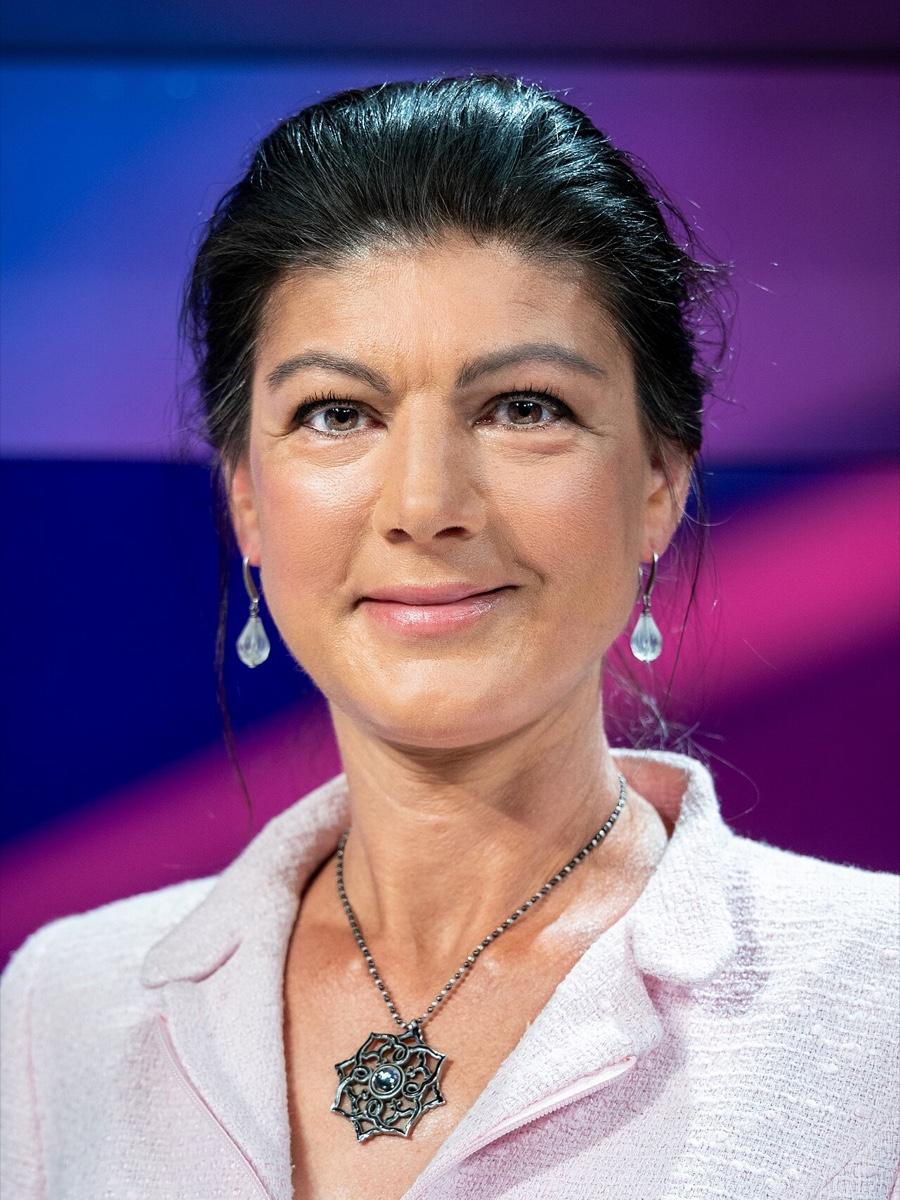
PoliticianPolitical leaning: Center-rightProfile last reviewed: 2026-07-30
Sahra Wagenknecht
Founder and co-leader, Bündnis Sahra Wagenknecht (BSW)
Left-economic populism combined with social-conservative positions on migration and culture; emphasizes diplomacy over military escalation.
Former Die Linke parliamentary leader who founded BSW in 2024. Positions herself as a peace-oriented alternative in eastern Germany, mixing redistribution and industrial policy with strict migration rhetoric and skepticism toward Ukraine arms deliveries.
Basis for the leaning assessment
Economically left of center on welfare and corporate power, but culturally conservative on immigration and skeptical of NATO-aligned Ukraine policy—net slightly conservative-leaning on the site's US-style axis.
Current Stances
Stances are editorial interpretations, always shown with the statements and actions they rest on.
War & Peaceobserved 2024 – 2025
Supports negotiated settlement and reduced arms flows; demands transparency on Nord Stream sabotage.
Supports negotiated settlement and reduced arms flows; demands transparency on Nord Stream sabotage.
Supporting statements & actions (4)
2024Speech
In a Berliner Zeitung interview, Wagenknecht rejected being labeled a voice of Russia, calling such defamation sick and insisting she advocates negotiated peace rather than prolonging the war.
Paraphrased coverage on war-and-peace
2024-08Speech
Zeit reported Wagenknecht's push for a Bundestag investigative committee into the Nord Stream pipeline explosions, framing unanswered questions about the attacks as central to Germany's energy and security debate.
Paraphrased coverage on war-and-peace
2024-08-29Speech
Goals
What Sahra Wagenknecht said they would do, in their own words and dated. Where the record settles one, the source for that is shown too. The same goals across everyone are in the promise tracker.
Short-term
Medium-term
Consistency Tracker
Does each new statement or decision square with the record? Verdicts are not accusations: both sides of the record are presented so readers can judge for themselves. The same readings across everyone on the site are in the consistency index.
Earlier statement / action
2024Speech
In the Berliner Zeitung interview, Wagenknecht linked her economic program to reducing inequality, stressing that ordinary workers should not bear the costs of corporate profits and energy-price shocks.
Paraphrased coverage on inequality
Later statement / action
2025Speech
Campaign messaging cited in t-online coverage included Wagenknecht's call for an immigration Atempause—a temporary pause—to relieve pressure on housing, schools, and public services.
Paraphrased coverage on immigration
Wagenknecht presents BSW as a workers' party defending the welfare state, yet her Atempause and border rhetoric overlap with CDU/CSU themes. Supporters call this a coherent 'social' conservatism; critics say it borrows from the far right while claiming anti-fascist credentials.
Most-Cited Sources from Voterscommunity reading list
Articles readers attached to their poll votes as evidence. Only pages cited independently by two or more voters are listed.
- 1www.reuters.com/world/europe/peace-advocate-promises-break-eastern-germanys-impasse-2024-08-29 ↗
Cited by 8 voters
Liberal 3Conservative 5 - 2www.zeit.de/politik/deutschland/2024-08/sahra-wagenknecht-nord-stream-anschlaege-untersuchungsausschuss ↗
Cited by 6 voters
Liberal 2Conservative 4 - 3
Timeline of Statements & Actions7 records, newest first
2026-07Speech
Brussels Signal reported that Wagenknecht's party pushed to break the AfD firewall before eastern German state elections, arguing conservative parties should not treat BSW and AfD identically.
Paraphrased coverage on democracy-institutions
2025Speech
Campaign messaging cited in t-online coverage included Wagenknecht's call for an immigration Atempause—a temporary pause—to relieve pressure on housing, schools, and public services.
Paraphrased coverage on immigration
2025Speech
In a t-online podcast interview during the Bundestag campaign, Wagenknecht criticized Germany's Ukraine policy, arguing continued military support prolongs suffering and that diplomacy should take priority.
Paraphrased coverage on war-and-peace
2024-08-29
More from Germany
Share this record
Every claim above carries its source, so the page holds up wherever it lands.