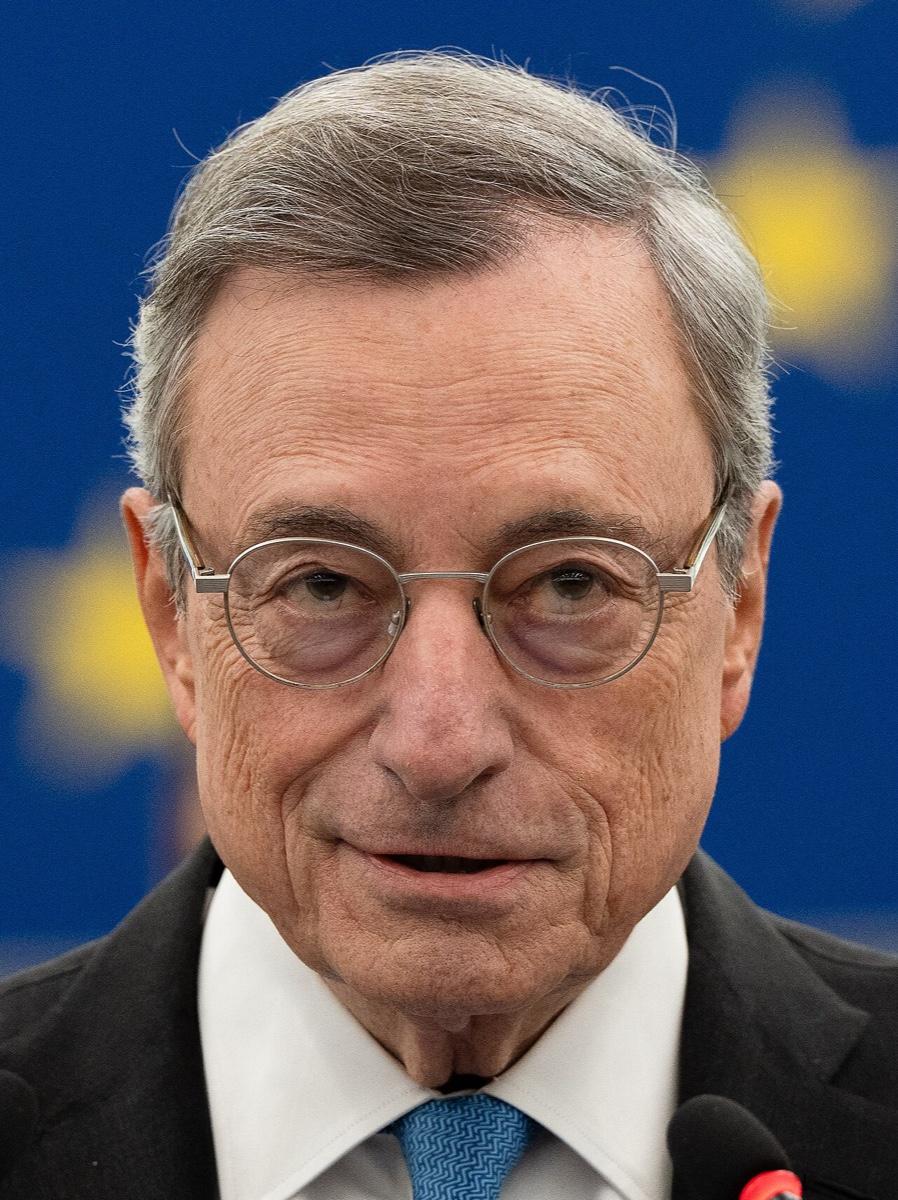
PoliticianPolitical leaning: CentristProfile last reviewed: 2026-07-30
Mario Draghi
Former President of the European Central Bank; former Prime Minister of Italy; Author of the EU Competitiveness Report
Technocratic Europeanist who warns that inaction threatens EU sovereignty, demands concrete dates over backloaded timelines, and urges joint financing and willing coalitions to close the AI, energy and defence gaps with the US and China.
Mario Draghi marked one year since his competitiveness report by telling Brussels that every challenge has worsened and inaction threatens European sovereignty. He criticises uncoordinated national state aid, calls for concrete deliverables, advocates joint debt for common projects, and urges pragmatic revision of 2035 automotive rules as market assumptions fail.
Basis for the leaning assessment
Centre on fiscal discipline with pro-integration federalist remedies — institutional reformist rather than partisan left or right.
Current Stances
Stances are editorial interpretations, always shown with the statements and actions they rest on.
Trade & Tariffsobserved 2025-09-16 – 2025-09-16
EU must escape dependency that forces deals on US terms
Anniversary speeches tie sovereignty loss to defence reliance on Washington and acceptance of trade deals largely on American terms.
Supporting statements & actions (2)
2025-09-16Speech
We have been painfully reminded that inaction threatens not only our competitiveness, but also our very sovereignty.
Brussels conference one year after the Draghi competitiveness report.
The sovereignty warning headlined EU coverage of Draghi's anniversary intervention.
2025-09-16Speech
Over the past year, each of these challenges has grown more acute — there is no clear path to finance the investments we need.
Anniversary speech blaming member states for slow, uncoordinated responses.
Goals
What Mario Draghi said they would do, in their own words and dated. Where the record settles one, the source for that is shown too. The same goals across everyone are in the promise tracker.
Short-term
Consistency Tracker
Does each new statement or decision square with the record? Verdicts are not accusations: both sides of the record are presented so readers can judge for themselves. The same readings across everyone on the site are in the consistency index.
Earlier statement / action
2024-09-09Publication
Europe will no longer be able to rely on many of the factors that have supported growth in the past — the report provides concrete recommendations to put Europe onto a different trajectory.
Official Commission page summarising the Draghi report's competitiveness diagnosis.
Later statement / action
2025-09-16Speech
Over the past year, each of these challenges has grown more acute — there is no clear path to finance the investments we need.
Anniversary speech blaming member states for slow, uncoordinated responses.
Draghi's defenders say the 2025 speech proves his 2024 diagnosis was prescient. Frugal-capital critics argue he uses worsening data to push federal borrowing they reject. Both documents describe structural growth exhaustion requiring coordinated action.
Most-Cited Sources from Voterscommunity reading list
Articles readers attached to their poll votes as evidence. Only pages cited independently by two or more voters are listed.
- 1www.eunews.it/en/2025/09/16/draghi-takes-aim-at-member-states-one-year-on-every-challenge-has-worsened ↗
Cited by 6 voters
Liberal 2Conservative 4 - 2commission.europa.eu/topics/competitiveness/draghi-report_en ↗
Cited by 5 voters
Liberal 2Conservative 3 - 3Liberal 3Conservative 1
Most-Discussed Moments
The statements and actions that set social media on fire — top 2, in chronological order. Every entry links to its source.
- 2025-09-16Speech
We have been painfully reminded that inaction threatens not only our competitiveness, but also our very sovereignty.
Brussels conference one year after the Draghi competitiveness report.
The sovereignty warning headlined EU coverage of Draghi's anniversary intervention.
- 2025-09-16Speech
The decarbonisation targets for the automotive sector are based on assumptions that are no longer valid — the transition must be flexible and pragmatic.
Call to revise 2035 CO2 rules with technology-neutral approach as EV rollout lags.
Draghi's 2035 rethink aligned with automaker lobbying but framed as competitiveness realism.
Timeline of Statements & Actions7 records, newest first
2025-09-16Speech
The decarbonisation targets for the automotive sector are based on assumptions that are no longer valid — the transition must be flexible and pragmatic.
Call to revise 2035 CO2 rules with technology-neutral approach as EV rollout lags.
Draghi's 2035 rethink aligned with automaker lobbying but framed as competitiveness realism.
2025-09-16Speech
The next logical step would be to consider joint debt for common projects, either at EU level or among a coalition of member states, to amplify the benefits of coordination.
Draghi on financing competitiveness through enhanced cooperation and shared borrowing.
2025-09-16Speech
We must move beyond broad strategies and backloaded timelines — we need concrete dates and deliverables, ambitious enough to demand real focus and collective effort.
Demand for accountability modeled on Single Market and euro success.
More from Italy
Share this record
Every claim above carries its source, so the page holds up wherever it lands.